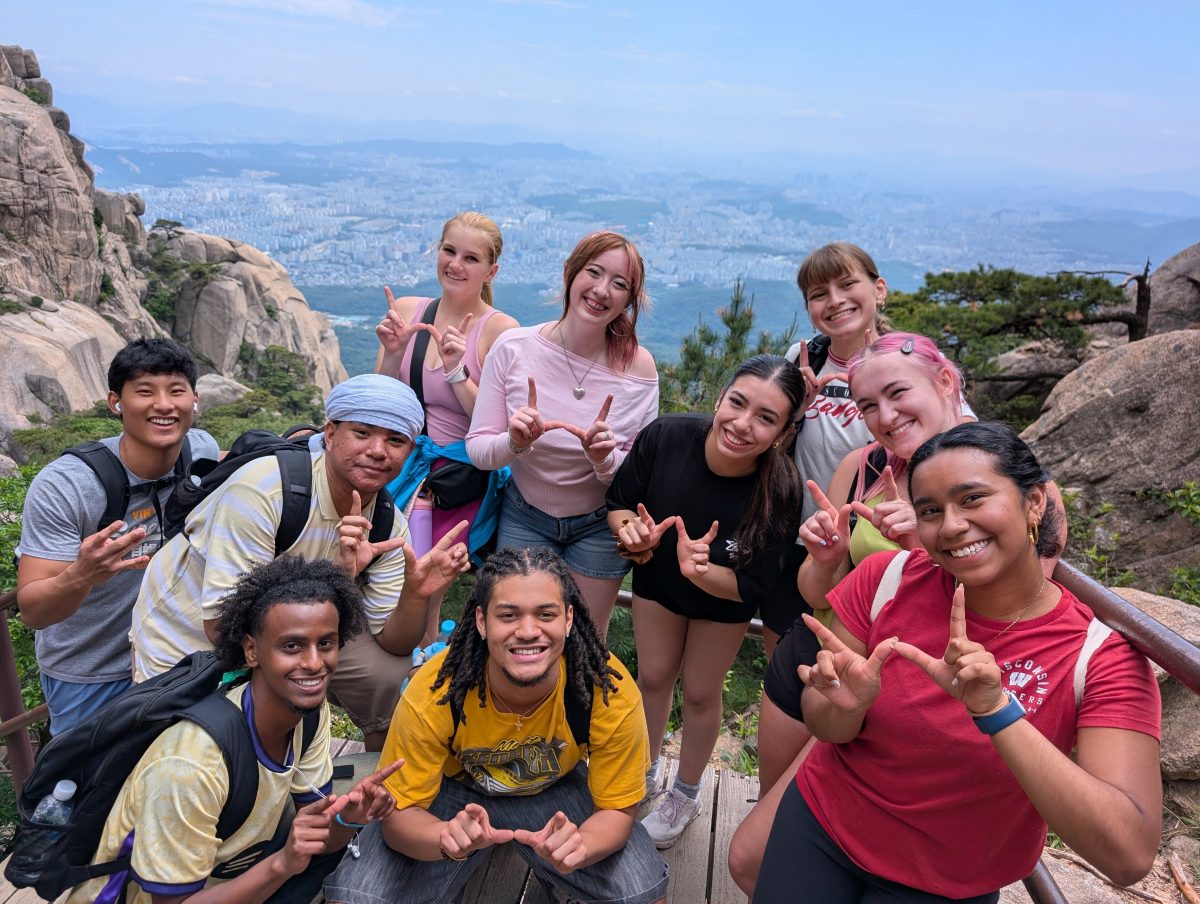
At the end of Ella Logterman’s first day in South Korea, she texted her parents to say she wanted to live there.
Logterman, a UW–Madison Korean language and culture studies major from Delavan, Wisconsin, developed an interest in Korea through its media and later became increasingly drawn to its language and culture. Logterman knew that getting to know Korea meant looking beyond contemporary culture.
“You have to learn the history to understand the culture,” Logterman said.
That connection between past and present was at the heart of the 2026 Global Gateway Korea program, a three-week faculty-led experience that brought UW–Madison students to the places where much of the history they were studying actually unfolded.
This summer, 76 students participated in three-week programs in Chile, Estonia, Ghana, Korea, and Washington, D.C., examining topics ranging from climate change and national development to politics, psychology, and geopolitical history.
The initiative is designed to make global learning more accessible. With support from the Office of Student Financial Aid and the Division of Enrollment Management, Global Gateway covers tuition, program fees, and airfare, helping reduce financial barriers that can keep study abroad out of reach for some students.
Led by David Fields, associate director of the Center for East Asian Studies, the Korea program examined relations between the United States and the Korean Peninsula from the 19th century to the present. Students explored questions about Japanese colonization, Korea’s division after World War II, the Korean War, the development of South Korea and North Korea, and the United States’ continuing role on the peninsula.
Fields saw leading the study of Korea’s past and present in-country as a unique opportunity for students, making the entire nation their classroom.
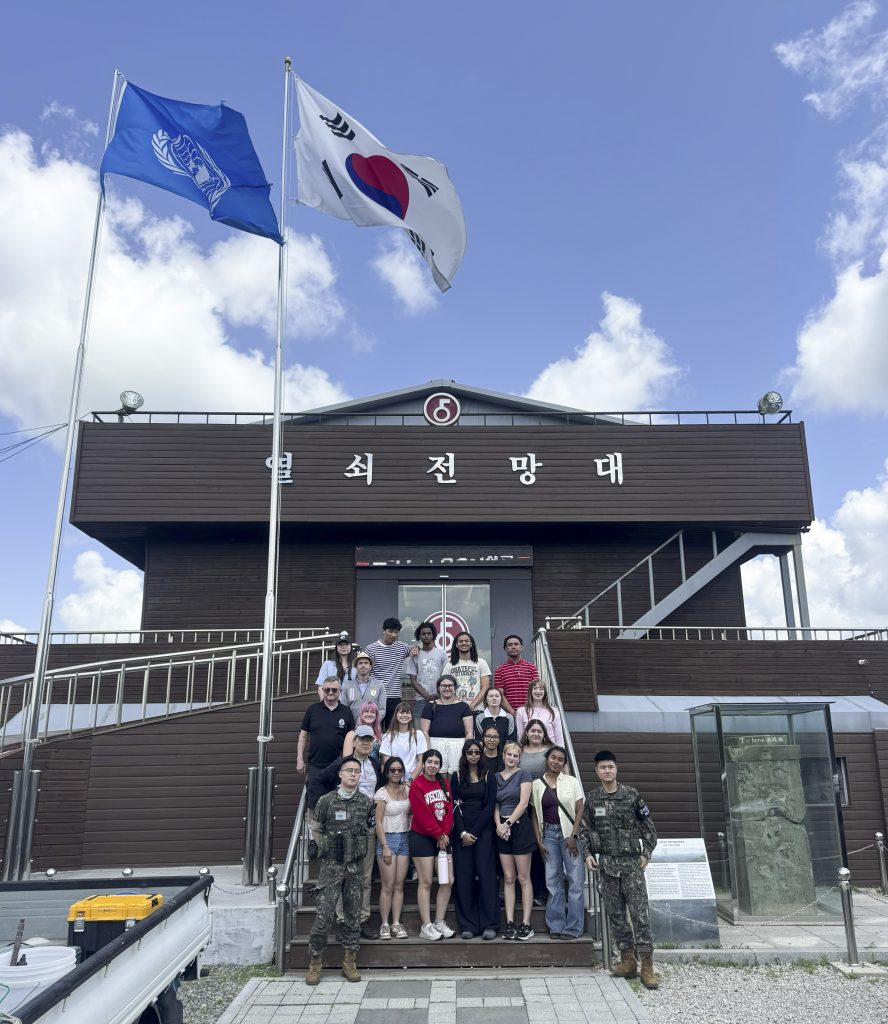
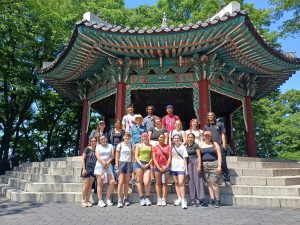
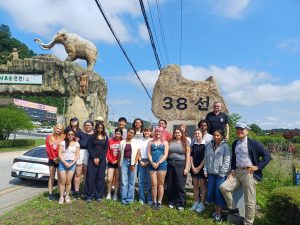
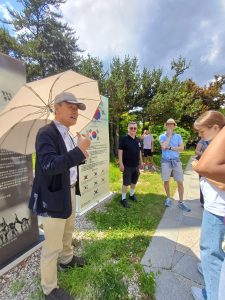
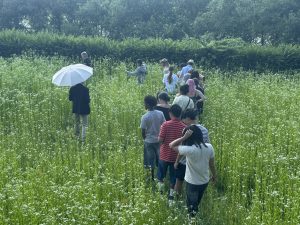
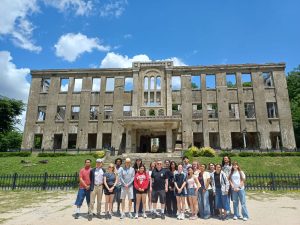
Students toured the War Memorial of Korea and Korean War battlefield sites. Visits to organizations such as Liberty in North Korea and the East Asia Foundation provided perspectives on contemporary political and regional issues. Trips to Ganghwa Island and the DMZ added another dimension to discussions of conflict, division, and U.S.–Korea relations.
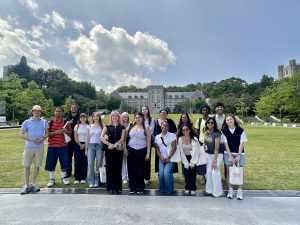
Other experiences widened the view. Students visited Korea University, toured Hanwha Ocean’s shipyards, and spent time in Busan, where they visited the United Nations Memorial Cemetery, Millak Market, and Gwangalli Beach. A stay at Haeinsa Temple offered a peaceful setting for living Korean history and culture.
For Fields, some of the most satisfying moments came when students recognized connections between what they had studied and what they were seeing.
“That’s what I was really hoping would happen, is that the classroom experience would reinforce the travel experience,” Fields said. “That went better than I think I possibly could have hoped.”
Those connections took different forms for a cohort with myriad academic interests, from political science and international studies to data science, political science, information science, biology, social work, medicine, and Korean studies.
Bryna Walters, an English and theatre and drama major from Horicon, Wisconsin, with certificates in political science and integrated liberal studies, was traveling outside the United States for the first time. She found herself immersed in a demanding schedule that packed coursework, site visits, cultural activities, and travel into three weeks.
“We do so much in a short amount of time, and it has all been so cool,” Walters said. “I don’t know what I would have done without the program.”
Other students approached Korea through their own academic and professional goals.
Political science major Cory Luong, who hopes to become a national-level policymaker, saw the experience as providing knowledge that could inform decisions later in his career.
Lizbeth Morales, a biology and international studies major on a pre-med track, viewed developing greater cultural fluency as important preparation for providing care to people from different backgrounds.
For information science major Aubrie Hanna, Korea offered an opportunity to view the design and usability of websites and apps from a different perspective.
Logterman, who hopes to become a Korean language interpreter or teach English in Korea, deepened an interest that had already shaped her studies and future plans.
“Originally, I fell in love with the media, but now it is the entire culture that has drawn me in,” she said.
The experiences beyond the curriculum may have been among the most memorable for participants.
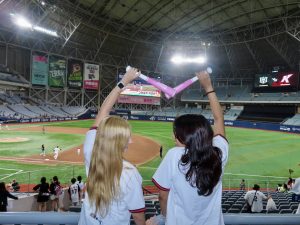
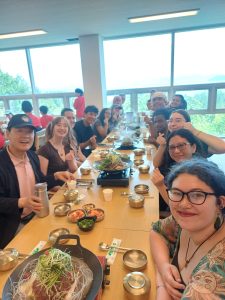
Students hiked, tried unfamiliar foods, explored markets and neighborhoods, took a K-pop dance class, and navigated Korea during their free time. Those opportunities created a singular experience—one built through observation, conversation, and the challenge of finding one’s way in an unfamiliar place.
Now that students have returned from Global Gateway Programs around the world, they can integrate those experiences into their future goals and adapt how they view the world. Having studied abroad as a student, Fields knows opportunities like this can be transformational.
“I’m delighted that our university has the Global Gateway Program,” Fields said. “Study abroad changed my college education and my life trajectory in a fundamental way. And I love that our university leadership has made resources available not just to maintain Global Gateway, but to expand it so even more students can participate.”
Story by Steve Barcus