When an international faculty member joins the University of Wisconsin–Madison, they often hear about the Wisconsin Idea—the principle that the university’s influence should reach every family in the state and beyond. For many, it is a new concept to study. But for Rajdeep Khangura, discovering the Wisconsin Idea felt less like an introduction and more like a homecoming.
It started with a sandwich.
In June 2025, Khangura arrived in the College of Agricultural and Life Sciences (CALS) as part of the RISE-EARTH initiative. During his first week on campus, hungry and in search of food, his co-worker recommended the Babcock Dairy Store for a sandwich. After arriving and placing his order for a “Bulky Badger” sandwich, he noticed a plaque honoring Stephen Babcock and the history of the Babcock test.

“I was like, ‘Whoa,’” he recalls. “I had no idea it was called the Babcock test. It was something I had been doing since I was seven years old.”
Growing up in the small village of Baranhara in the Punjab region of northern India, his life revolved around the rhythm of the farm. His mother ran the family’s dairy operation while his father managed the crops. In their village, they also ran a milk cooperative where local producers—some with only two or three animals—would bring their yields. The farmers were paid based on fat content, measured by a specific chemical test.
At the time, he was just a boy helping his parents measure milk fat content. He didn’t know the test had been perfected on the other side of the world in Madison, Wisconsin.
“It wouldn’t be a stretch to say that I’m here today because of the Babcock test,” said Khangura. “The economic progress we were able to make. My family and the community around us benefited from the dairy industry that the Babcock test helped establish. And as a result, I was able to get a better education and be in a position to pursue higher education in the U.S.”

A few months after arriving at UW–Madison, Khangura attended the new faculty orientation and listened to people discuss the Wisconsin Idea in the context of the state of Wisconsin. “But for me, knowing about the Babcock test at this point, I said to myself, ‘The Wisconsin Idea is way bigger than this. This is a global thing.’”
Now a “retired farmer” who does his farming at the West Madison Ag Research Station, Khangura’s research is focused on broad-spectrum disease resistance in cereal crops. While many breeding resources provide protection only against specific strains of a disease, he is investigating a distinct set of genes that can provide resistance to a wide array of pathogens. By targeting biological elements central to a pathogen’s establishment, he and his team are working to identify these genes in corn and wheat. His goal is to determine how these genes function and how they can be optimized to improve future breeding efforts for growers in Wisconsin and abroad.
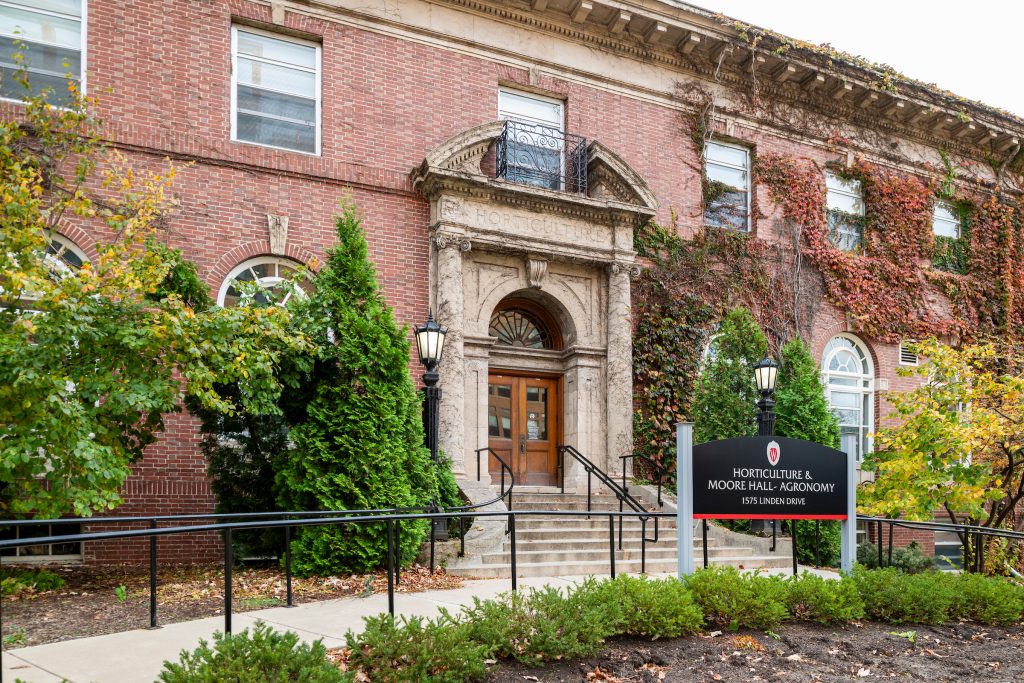
“I used to think of UW–Madison as a place for primarily upstream research, but I was totally wrong about that,” he said. “The amount of applied research here is unique. We have a potato breeder, an onion breeder, a beet breeder, a carrot breeder, your entire grocery store is basically captured in the Department of Plant and Agroecosystem Sciences and Moore Hall. And these are world-class scientists.”
 His perspective is shaped by a deep empathy for the gamble every farmer takes. “Someone described it to me as dollar bills hanging in the field,” Khangura explained. “You put everything into growing it, but you don’t get that return until harvest. If there is extreme weather, you can lose it all.”
Despite the complexity of his current research, the connection to his roots remains a constant source of inspiration. “It still gives me goosebumps,” he said. “I took a picture of the Babcock plaque and sent it to my dad. I told him, ‘Dad, you won’t believe this’ because that was the start of my journey in agriculture and dairy.”
For Khangura, the Wisconsin Idea is more than a plaque on a wall or a lecture in an orientation; it is a global, living exchange of progress. As he works to protect the next generation of farmers, he is ensuring that the same innovation that built his family’s past will help secure Wisconsin’s future.
Story by Kayla Daum