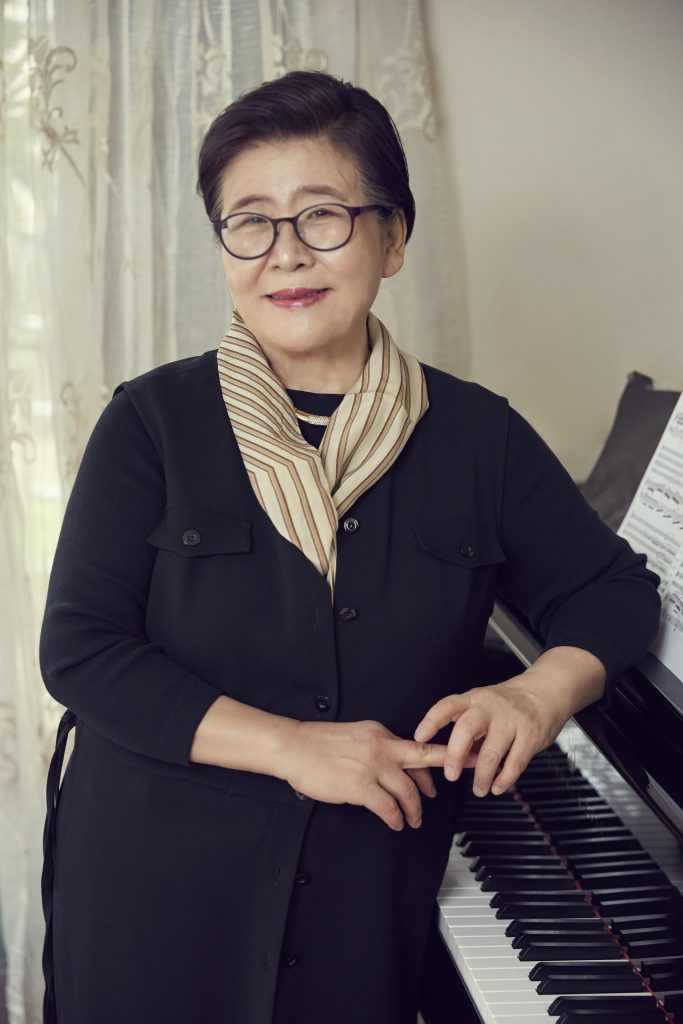
Before Yung Hae Chun had a piano, she had a piece of paper.
Her mother drew a keyboard across it so her young daughter could practice even when no instrument was available. In the years following the Korean War, a piano was a rarity where Chun lived. She recalled an entire city having one or two. She practiced on whatever she could find, even seizing the opportunity to play an old, out-of-tune piano at her elementary school.
Today, Chun has three grand pianos at home.
This contrast spans an incredible musical life. Chun became the first person in Korea to earn a Doctor of Musical Arts (DMA) degree, receiving her DMA from the University of Wisconsin–Madison. She went on to become a professor and dean at Kyung Hee University, mentor generations of musicians, and build an international career as a concert pianist.
And she is still practicing.
“Inside of my mind, I still have the goal to be a better pianist,” Chun said. “That’s why I always practice.”
Chun was 6 when the Korean War upended her childhood. She remembers seeing troops, tanks, and guns outside a government building before her family eventually fled south, where her grandfather lived.
Her mother remained determined that her daughter would learn the piano, even with the scarcity of instruments. Chun walked to a teacher’s home for lessons and sought out whatever pianos she could find for practice. When none were available, she practiced on her paper keyboard at home.
Her mother once imagined Chun becoming both a lawyer and musician—practicing law during the day and giving concerts at night. But when it came time to choose between a general high school and Seoul Arts High School, Chun confidently chose music.
“I cannot live without music,” she recalled thinking.
After completing high school and then graduating from Seoul National University, Chun looked abroad to further develop as a pianist. She initially considered pursuing a performance career in New York, but Wisconsin offered another possibility: advanced musical training paired with a doctoral degree.
She first spent a year at a conservatory in Milwaukee, where the dean encouraged her to continue to Madison, believing her strengths in areas such as music theory and history made her well suited for a doctoral program. At the time, DMA programs were still relatively uncommon in the United States and did not exist in Korea.
UW–Madison offered Chun the opportunity she desired: to develop as a performer while earning the highest academic credential in her field. She would do so under the guidance of prolific faculty and renowned pianists, including Paul Badura-Skoda, Gunnar Johansen, and Howard Karp.
“Originally I wanted to be a good performer,” Chun said. “But then I thought if I am a good performer, I’ll be a good teacher also.”
Earning the DMA placed her in uncharted territory when she returned to Korea. The degree was so new there, Chun recalled, that people wondered what it meant to be a “doctor” of music. For another decade or more, she said, DMA holders remained uncommon in the country.
Chun immediately joined Kyung Hee University as a professor, beginning a career in higher education that would eventually see her serve as dean of the university’s College of Music. Over the course of her career, she has taught more than 100 students while maintaining the professional performance career that drew her to music in the first place.
Balancing both required discipline. Even during the busiest years of teaching and raising a family, Chun made a point of finding at least three hours each day to practice.
That commitment never disappeared.
Chun has performed chamber music in Europe, appeared with the Moscow Chamber Orchestra, given concerts and master classes, and continued performing worldwide into recent years. She performed in Hanoi to mark 30 years of diplomatic relations between Korea and Vietnam. Chun marked her 80th birthday with a concert that brought together 16 of her students playing across four pianos, including an arrangement of Beethoven’s Symphony No. 5. She also performed Beethoven’s final piano sonata.
Her approach to performance favors depth. She has devoted entire programs to individual composers, including Bach, Beethoven, Chopin, and Schubert, believing sustained attention allows a pianist to reach further into a composer’s work.
Today, she often practices at night. Decades of repetition have not diminished her curiosity. If anything, Chun believes the years of practice have deepened what she can bring to the instrument.
“When I was young, it was difficult to practice,” Chun said. Now, she explained, sitting at the piano allows the concerns of the present to disappear.
Since her earliest days at the piano, the instrument, setting, and stage may have changed, but her passion for music has only grown stronger.
“Music gives you life,” Chun said. “I tell my students that if you seek this, then you will be much happier.”
Story by Steve Barcus